

The Scottish dirk is a long dagger of historical origin, closely linked to the culture of the Scottish Highlands.
It emerged in the 17th century as part of the traditional weaponry of Scottish clans and evolved from a simple utility knife to a symbol of honor and status.
This article presents a historical overview of the origin, evolution, functions, and relevance of the dirk within the Scottish military and social context.

Origin and historical evolution
The Scottish dirk is derived from the medieval long knife known in Scotland as the "ballock dagger" or "bollock dagger", characterized by a testicle-shaped handle (hence its name).
At the beginning of the 17th century, this knife was stylized and adapted by Highland warriors for both utilitarian and military purposes. The term "dirk" began to be widely used in that century.
According to military and civil documents, it was an essential piece of equipment for a clan warrior.
It was carried alongside the basket-hilted broadsword, and was used as a backup in close combat.
Physical characteristics of the dirk
Historically, the Scottish dirk has the following characteristics:
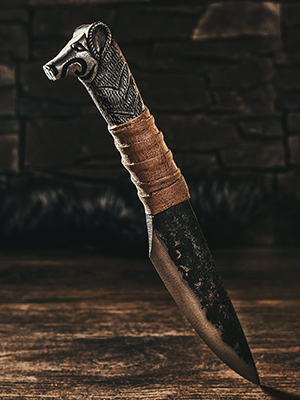
· Blade : straight, single-edged, with an average length of between 25 and 40 cm. Its design allowed for powerful stabs, especially in close combat.
· Grip : Made of wood (usually boxwood), without a guard, with a conical shape that adapted to the hand. Often carved with geometric designs or clan motifs.
· Decoration : From the 18th century onwards, many dirks were embellished with inlays of silver, brass and semi-precious stones, such as cairngorm , a variety of smoky quartz typical of Scotland.

The dirk in the military context
The dirk was used by Scottish clans during the Wars of the Three Kingdoms (1639–1651), and later in the Jacobite risings (notably the campaigns of 1715 and 1745), where Highlanders fought for the restoration of the House of Stuart to the British throne.
During these conflicts, traditional Scottish weaponry consisted of the basket sword, the dirk, and a small concealed knife known as a sgian dubh, which was carried in the stocking or sock.
The dirk was used both as a secondary defensive weapon and to finish off the enemy in battle.
Following the Jacobite defeat at Culloden (1746), the British government enacted the Act of Proscription, which prohibited the carrying of traditional weapons such as the dirk. However, its use persisted in ceremonial contexts.
The dirk in the ceremonial sphere
Beginning in the 18th century, the dirk took on a symbolic function. Scottish officers in the British Army began wearing ornate versions as part of their formal uniform.
Today this custom is still alive among Scottish regiments of the British Army, such as the Black Watch or the Royal Highland Fusiliers.
It is also part of the civil formal attire at events such as weddings, clan gatherings or official celebrations, always associated with the kilt and tartan of the corresponding clan.

A dagger that is part of History
Numerous original dirks are preserved in British and Scottish museums, such as the National Museum of Scotland in Edinburgh and the Royal Armouries Museum in Leeds.
Notable exhibits include inscriptions, clan emblems, and records of membership of historical Highland figures.
The Scottish dirk is a fundamental piece of Scotland's military and cultural heritage.
Born as a practical combat weapon, it came to symbolize the resilience, honor, and identity of the Highland clans.
Its evolution from a tool of war to a ceremonial object reflects Scotland's transformation following internal conflicts and integration into the United Kingdom.
Today, the dirk remains an emblem of tradition and pride for Scotland.