


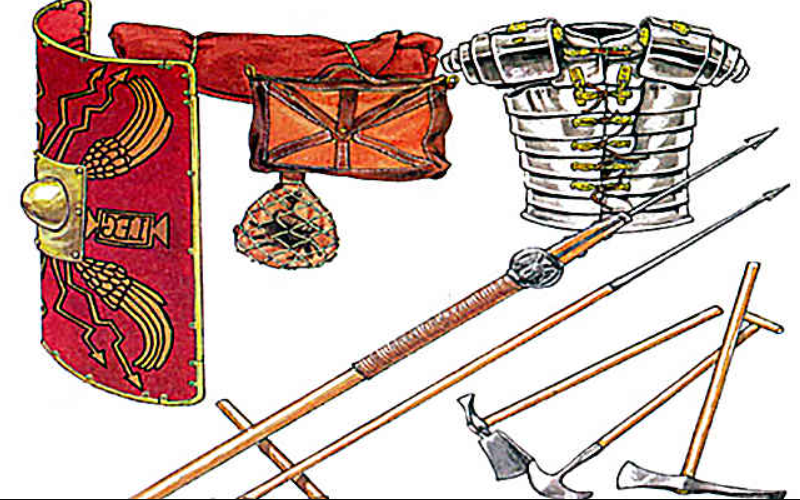
The military machinery of the Roman Empire was not only distinguished by the discipline and organization of its troops, but also by the variety of weapons it placed in the hands of its soldiers.
While swords and shields often feature prominently in imperial iconography, polearms and axes played an essential role in the tactical and logistical development of the army, from Caesar's legions to the border defenses of the Late Empire.

The power of Roman polearms
Polearms were long weapons mounted on a wooden shaft, designed for long-range combat or as support in close formations.
One of the most iconic was the pilum, a throwing spear used by Roman legionaries.
Its clever design, with thin, soft iron that bent on impact, prevented the enemy from reusing it and served to disable their shields.
It was launched just before the close-quarters clash, opening up the enemy formation.
Along with the pilum, there were other pole weapons such as the hasta, a non-throwing combat spear used by the triarii in Republican times.
During the imperial period it was used mainly by auxiliary troops and cavalry.
In some cases it was decorated with tassels or votive elements.
During the reforms of the 3rd century AD, with the appearance of new units such as the comitatenses, longer and heavier variants of the lance emerged, designed to penetrate enemy armor and cavalry, such as the contus or the verutum, the latter of Italic origin, shorter than the pilum and used by both infantry and cavalry.

Roman axes: more than just tools
Axes were not as common as other weapons in Roman armament, but they did have a specific place, especially in auxiliary, engineering, or siege contexts.
The dolabra is a representative example: a combination of axe and pickaxe, used both to open trenches and to break enemy palisades.
Its dual function made it an essential tool for the legionaries in charge of fortification tasks.
Another variant was the trench axe, used in sieges or skirmishes in urban or forest environments.
These axes were smaller, with wide, robust blades, capable of penetrating light protection.
In some cases they were adapted as improvised weapons in close combat.
There are also representations of ceremonial axes, in the form of votive offerings or in officers' tombs, suggesting a symbolic or ritual use linked to power or authority within certain units.

Presence in museums
Numerous examples and fragments of Roman polearms and axes have been found at military sites and fortified camps.
Some of the most relevant ones can be visited at:
- Xanten Museum (Germany) , with original pilum found in the Rhine castra.
- British Museum (London) , which preserves dolabrae and verutum from Britannia.
- National Archaeological Museum (Madrid) , where metal axe heads and shafts from military use found on the Iberian Peninsula are on display.
- Musée de Saint-Romain-en-Gal (France) , with spears and tools of legionary engineers from the 1st century AD

Tools and weapons that maintain their glory
Roman axes and polearms were fundamental pieces in the effectiveness and adaptability of the Roman army.
From the lethal pilum to the sturdy dolabra, these weapons reveal the pragmatic and technical nature of a military machine that knew how to combine tools of war, engineering, and symbolism.
Although less glorified than swords, their legacy lives on in museum display cases and in the knowledge of the warlike history of the ancient world, as well as in the replicas that keep them alive for collectors and enthusiasts.