
More than a weapon, an inheritance
Few weapons evoke the spirit of the Norse peoples as much as the Viking axe. Used from the 8th to the 11th century, it played a leading role not only in epic battles but also in the daily lives of peasants, merchants, and nobles.
From their simplicity to their imposing symbolism, these axes reflect the very soul of Viking culture. Their technical evolution and ritual importance make them key pieces for understanding the worldview of the medieval North.

Origin and history:
The birth of a symbol of war
The use of axes in Scandinavia dates back to pre-Viking times, but it was during the Viking Age (ca. 793–1066 AD) that their design was perfected and their military function consolidated.
Unlike swords—expensive and reserved for the elite—axes were accessible to every warrior and could be made with less iron.
Anglo-Saxon and Frankish chronicles frequently mention the destructive power of these weapons in raids and battles.
Types of Viking axes
Variety according to function and range
There are multiple variants of Viking axes, among which the following stand out:

Danish axe
With a wide blade and long handle, ideal for two-handed combat.
Used by the Varangian guard.
(Photo of the Viking Long Axe )

Bearded axe (Skeggöx)
Also called "Barbuda" in Spanish.
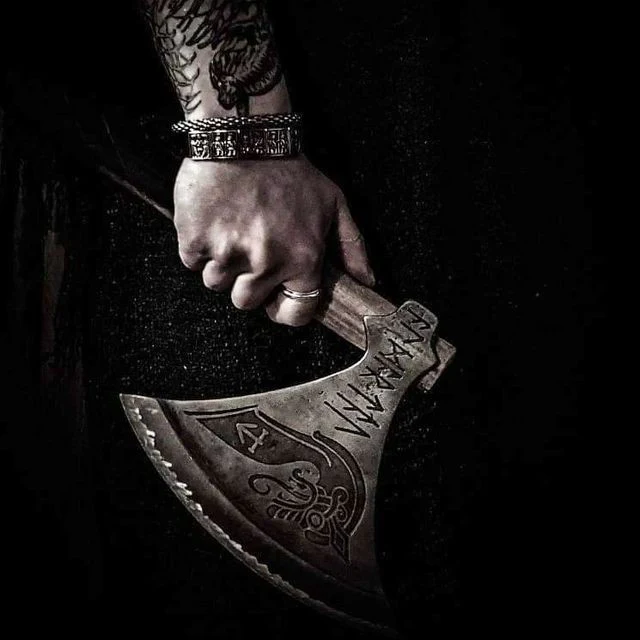
With a blade that extends downward like a beard, it allowed greater control and grip for everyday tasks.
(Photo of the Bearded Axe, Forged, with Antique Finish )

Short or utility axe
More compact, used for agricultural tasks, carpentry or as a secondary weapon in battle.
(Photo of the Small Viking Axe )

Ceremonial axes
Richly decorated, not designed for combat, they were used in rituals or as funerary offerings.
(Photo of the Mammen Ceremonial Viking Axe )
Functions and symbolism: between life and death
Axes weren't just tools or weapons. In the Viking symbolic universe, they represented strength, protection, and status.
They have been found buried alongside warriors as part of their funerary trousseau, indicating their importance in the journey to Valhalla.
Some were engraved with protective runes or ritual inscriptions.
In addition, they were associated with deities such as Thor, whose strength was channeled through the use of blunt weapons.
In legend, the axe was also an extension of the warrior's honor. Carrying a finely forged axe was a sign of respect for the just war, ancestral tradition, and the power of the ancestors.
Viking axes in museums: vestiges of the past
Viking axes have been recovered in hundreds of archaeological excavations, and today many are on display in major museums around the world:
- National Museum of Denmark (Copenhagen): Displays axes from different Viking eras, from utilitarian to ceremonial.
- Swedish Historical Museum (Stockholm): It has specimens decorated with zoomorphic and plant motifs.
- British Museum (London): Houses axes found in York and other Viking settlements in England.
- Viking Ship Museum (Oslo): Offers reconstructions of grave goods where axes take center stage.
These objects allow us to study everything from forging methods to the evolution of their design, materials, and social context.

The edge that forged a civilization
Viking axes are emblems of an era of expansion, culture, and mythology. They represent not only the art of war, but also the social, spiritual, and economic fabric of the Norse peoples.
Their functional variety and deep symbolic meaning make them fundamental pieces of European history.
Still visible in museums today, these weapons remind us that behind every blade lies a story worth telling.
You will find these and more Viking and Axe products in our Medieval Shop .