



Since the dawn of Arthurian literature, two names have resonated with mythical force: Excalibur and Caliburn. Both swords are associated with King Arthur, but their origin, meaning, and function have sparked historical, literary, and philosophical debates for centuries.
Are they the same sword with different names? Or do they represent two different legendary items?
This article delves into the medieval texts, Celtic legends, philosophical interpretations, and modern theories surrounding these iconic weapons.

The literary origin: Caliburn in Geoffrey of Monmouth
The first documented use of the name Caliburnus appears in Geoffrey of Monmouth's Historia Regum Britanniae (1136), where Caliburn is described as the mighty sword of King Arthur, forged on the mythical island of Avalon.
Its name probably derives from the Latin chalybs ("steel") and the Welsh Caledfwlch , suggesting a Celtic origin.
In this version, there is no mention of the sword in the stone, but Caliburn is simply an invincible sword.
Excalibur in later Arthurian evolution
Over time, the name Caliburn transformed.
In the French versions of the Arthurian cycle—especially in the works of Chrétien de Troyes and later in the Arthurian Vulgate —the name evolved into Escalibor and finally Excalibur.
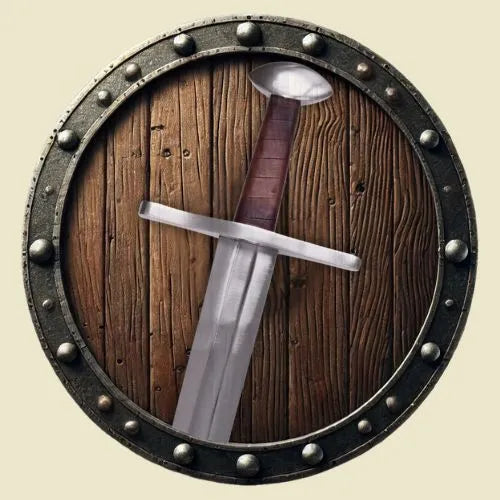
In Sir Thomas Malory 's Morte d'Arthur (15th century), Excalibur is already the definitive canonical name. But here the complexity arises: Malory distinguishes between the sword in the stone, which Arthur extracts as proof of his right to the throne, and Excalibur, which he receives from the Lady of the Lake.

One sword or two?
There are two main lines of interpretation:
The same sword with different names
For some scholars, Caliburn and Excalibur are simply the same sword, whose name has been adapted over the centuries and translated between languages. The sword Arthur draws from the stone is said to be Caliburn (or Excalibur), and its delivery after his death to the Lady of the Lake represents a magical reassertion of his power.
Two different swords
In this version, the sword in the stone, Caliburn, represents political legitimacy, while Excalibur (the Lady of the Lake's) symbolizes spiritual and magical power. It is even said that the sword in the stone was broken in battle and that Excalibur was the new weapon bestowed by supernatural forces.

Philosophical and symbolic dimension
Both swords have profound meanings. Caliburn can be interpreted as the sword of strength and conquest. Excalibur, on the other hand, is more associated with divine royalty, the balance between power and justice, and the responsibility of the leader.
The fact that Excalibur is returned to the lake after Arthur's death reinforces its symbolic character: power does not belong to men, but is lent to them by higher powers.
Cultural influences and modern versions
In many modern adaptations (including films, video games, and novels), the two concepts tend to be unified under the name Excalibur. However, some works, such as Merlin (BBC) or Camelot 3000 , revisit the idea of two swords: one mundane and one magical.

Two symbols beyond the context
Although the debate about whether Excalibur and Caliburn are the same sword or two different ones continues, the truth is that both have left an indelible mark on Arthurian mythology. They represent the ideal of the righteous hero and the balance between earthly and spiritual power, eternal symbols that continue to inspire stories and popular culture.