





Origin and historical evolution
The carving knife is one of the most refined and ancient kitchen tools. Its origins date back to the Middle Ages, when royal banquets required specific utensils for elegantly and precisely carving roasted meats in front of guests.
Carving, from the Latin trin car e , meant "to cut into portions," and has since become a valued skill in palace kitchens, restaurants, and homes.
Over time, the carving knife evolved in both design and materials, adapting to culinary changes without losing its essential function: making clean, straight, and precise cuts in large pieces of meat, such as turkeys, roasts, or cooked hams.

Types of carving knives
Although its basic form is fairly standardized, there are slight variations depending on culture and usage:
- Classic carving knife: Long, thin, rigid, and very sharp blade with a pointed tip. Ideal for cutting cooked or roasted meat.
- Carving knife with alveoli: It has small holes on the sides to prevent slices from sticking to the blade.
- Chef's carving knife: More versatile, with a slightly wider blade that also allows for cutting poultry or large fish.
In addition, it is usually accompanied by a carving fork , with two long prongs, which stabilizes the piece during cutting without causing too much damage.

Importance in gastronomy and the home
The carving knife is highly relevant in both haute cuisine and domestic settings. In professional gastronomy, it allows for presenting meats in uniform slices that retain their succulence. At home, especially at celebrations like Christmas or family gatherings, its use adds elegance when serving a roast or a whole bird.
Carving correctly not only enhances the dish, but also respects the structure of the food, preventing it from tearing or losing essential juices.

Parts of the carving knife
Despite the variations that exist between different carving knives, they share some essential qualities and parts that, although present in other knives, are designed with features specifically tailored to their specific function.
Blade: Long (usually between 20 and 30 cm), narrow and rigid, made of stainless steel or carbon steel.
Edge: Smooth, very sharp, designed to cut without tearing.
Tip: Fine and sharp, useful for separating meat from bone or making precision cuts.
Spine: Upper part of the blade, thicker to provide stability.
Tang: The continuation of the blade into the handle. Full-tang blades are more durable.
Handle: Made of wood, polymer or steel, it must be ergonomic and non-slip to provide a secure grip.

Sharpening and caring for your carving knife
A carving knife must be kept extremely sharp to fulfill its purpose. To achieve this, it is recommended:
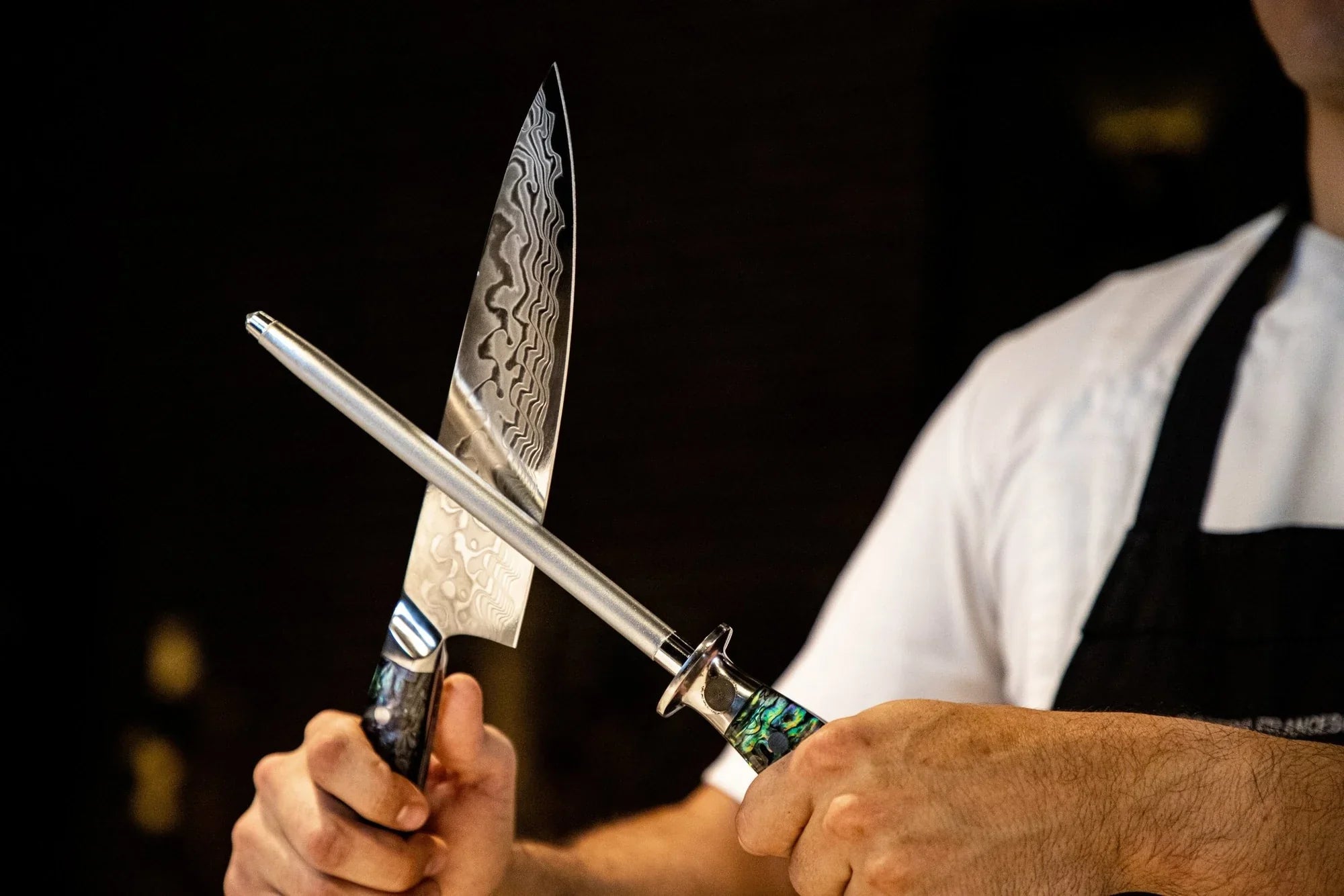
- Use a sharpening steel or honing rod before and after each use.
- Perform a professional sharpening or sharpening with a sharpening stone from time to time, depending on use.
- Wash by hand, never in the dishwasher, and dry immediately.
- Store it in a protective sheath, knife block, or magnetic kitchen bar.
- Do not use it for hard or frozen foods, which could damage the edge.
Proper maintenance prolongs its useful life and guarantees clean and safe cuts.
A fundamental tool for the art of cooking
The carving knife is more than just a utensil: it's an extension of the cook's hand, both in professional and home settings.
Its precision, elegance, and functionality make it an essential tool for those who value the art of serving good meat.
Knowing its types, parts, care, and usage techniques is essential to getting the most out of this kitchen classic.
Have you ever seen these children's carving knives ? You can find these and much more in our Medieval Shop .