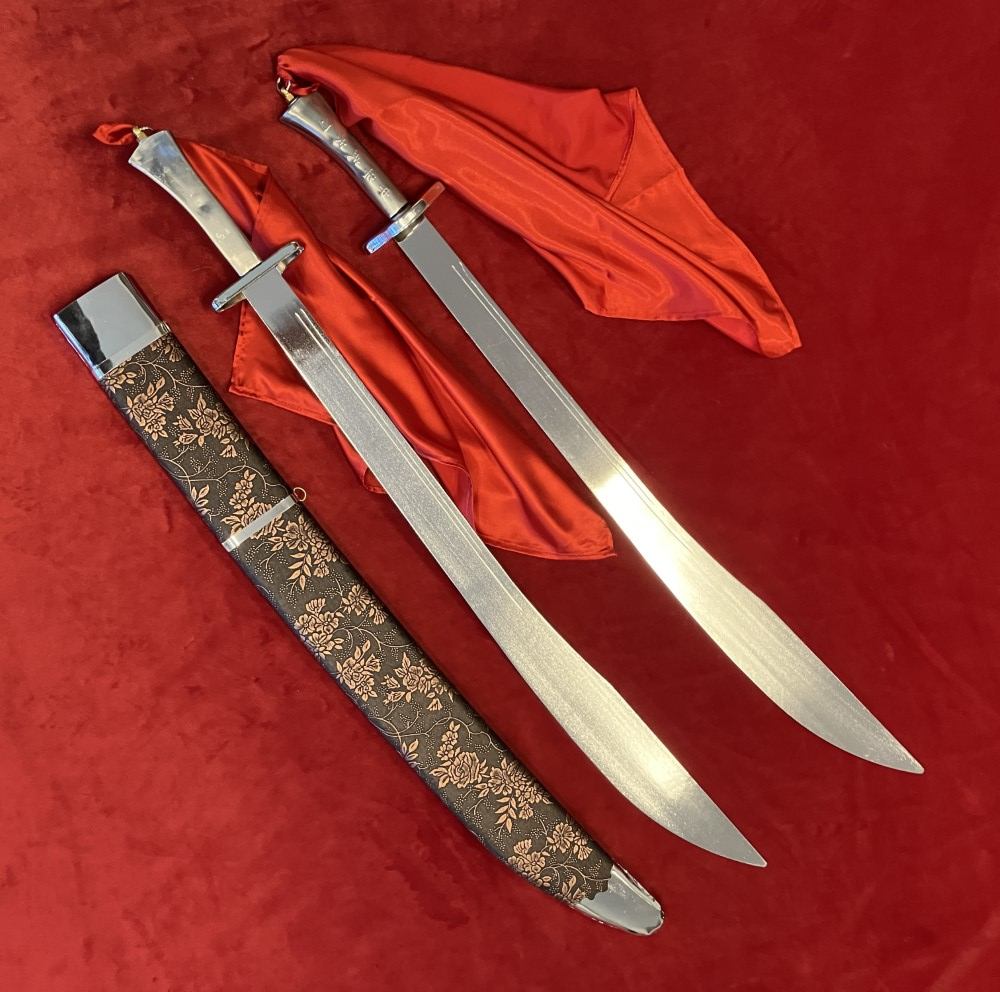
Chinese double dao swords are one of the most emblematic weapons of kung fu and traditional wushu.
These are two curved, single-edged swords wielded simultaneously, offering a perfect balance of elegance, speed, and power.
These weapons not only have martial value, but also profound cultural significance within Chinese history.
In this article, we'll discover its origins, its evolution to the present day, and some interesting facts that make double dao an icon of Chinese martial arts.

Origins of the Double Dao Swords
The term dao literally translates as “saber” or “single-edged knife.”
Unlike the straight sword jian, the dao is characterized by its curved edge, designed for powerful and fluid cuts.
Double Dao, or “shuang dao,” refers to the use of two swords at the same time.
Its origin dates back to the Han and Tang dynasties, when the dao was consolidated as a military cavalry weapon.
Its curved design facilitated quick cuts from horseback, making it the preferred weapon of soldiers and generals.
Over the centuries, double dao were incorporated into kung fu schools, perfecting themselves as a combat and martial training tool.
History of Chinese Double Dao Swords
During the Ming and Qing dynasties, the use of Dao swords became very popular.
Dao techniques and double-sword combinations are described in military manuals, such as the famous Wu Bei Zhi. However, their presence in actual battles was less common than that of other longer weapons, such as the spear or halberd.
Where they really shone was in the realm of traditional martial arts.
Kung fu schools such as Hung Gar, Shaolin, or styles from southern China, adopted double dao as part of their training.
These weapons required coordination, speed and strength, being a symbol of discipline and skill.

Double Dao Swords Today
Today, Chinese double-dao swords are widely used in modern wushu and kung fu displays.
In international competitions, practitioners demonstrate forms (taolu) with spectacular movements, quick spins and energetic cuts.
Their visual appeal makes them a favorite weapon in martial arts exhibitions and films.
In addition, they are manufactured for both training and collecting.
There are lightweight aluminum versions designed for tournaments, and more robust steel versions geared toward traditional practice.
Its aesthetics continue to fascinate collectors of historical weapons and lovers of Chinese culture.
Curiosities about the Double Dao
- Double Dao is also known as “butterfly swords” in some southern kung fu variants.
- In martial arts films, actors such as Jet Li and Donnie Yen have popularized its use in choreographed fights.
- Although visually spectacular, double dao techniques require years of practice and advanced coordination.
- The dao is considered the “king of short weapons” in Chinese tradition, while the jian sword is called the “lady of weapons.”
The Legacy of the Double Dao Swords
Chinese double dao swords represent much more than a combat weapon.
They are a symbol of Chinese martial tradition, a cultural heritage passed down from generation to generation and a key element in both traditional kung fu and modern wushu.
From its origins in ancient armies to its presence in modern films and competitions, Double Dao continues to captivate with its beauty, history, and power.